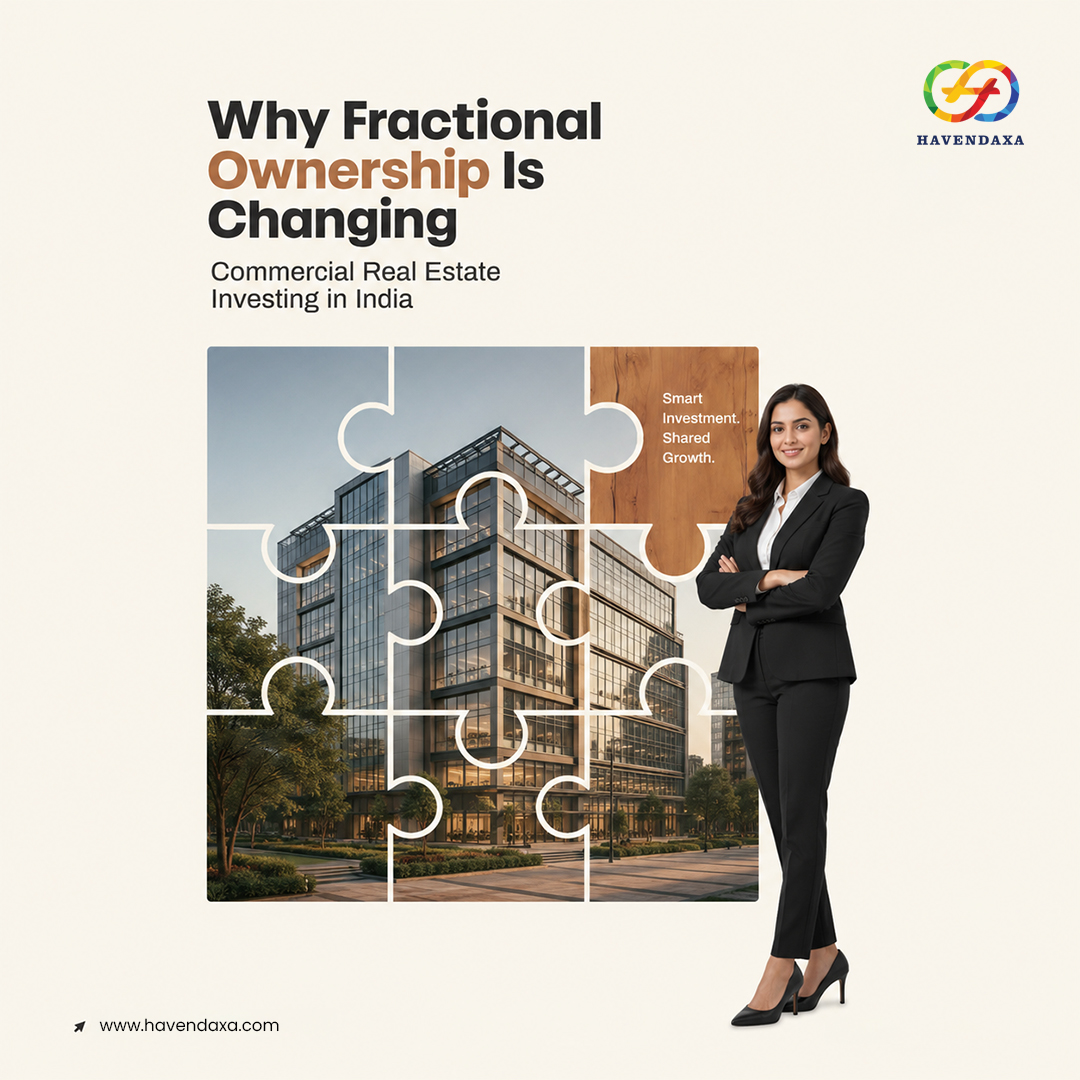
Why Fractional Ownership Is Changing Commercial Real Estate Investing in India
In the past, commercial real estate was perceived as an investment type available only to some individuals in India.
If you wished to purchase high-end office space, a warehouse, hotel, or any other high-end commercial real estate, you would need money in abundance. And owning such property was not just about purchasing but involved many aspects, such as paperwork, managing tenants, maintaining the property, leasing, etc.
For an ordinary investor, accessing this market was not that easy.
But this is changing.
Fractional ownership is slowly redefining how investors enter the commercial real estate market in India. Rather than purchasing the entire commercial property by yourself, several investors can pool in their resources to buy a premium commercial property and own a fraction of it.
This simple concept is revolutionizing the commercial property investment sector in India.
But then why should one choose fractional ownership? Could it be a game-changer in real estate investment in India?
Let us know.
What Is Fractional Ownership In Commercial Real Estate?
Fractional ownership is an arrangement where many investors collectively own a high-value real estate asset.
How does that work?
Let's say there is an excellent commercial real estate asset that is worth several crores. The traditional approach would require one investor or a company to buy the whole asset.
With the help of fractional ownership, the investment can be shared between several investors who will own a portion of the asset and can take part in the profits that it makes, depending on the particular investment and asset performance.
Such assets might include:
- Excellent office space
- Commercial real estate asset
- Warehouse
- Hotel
- Healthcare facility
- And any other income-producing commercial real estate asset
In essence, you don't have to buy the whole building to invest in commercial real estate.
Havendaxa and similar platforms make it easier for you to have access to premium income-producing real estate assets with the help of detailed property information, due diligence, ownership information, and asset management.
How Commercial Real Estate Investment Traditionally Was Not Easy
There is no denying the fact that commercial real estate was traditionally considered an area for investing due to rent generation and appreciation potential.
But there is one big drawback always associated with this type of real estate.
The entry barrier is very high.
A good commercial property situated in an excellent Indian locality will need crores of rupees. Even individuals having substantial savings will think twice before investing a huge chunk of their money on such an asset.
There are other factors too.
Investors will have to analyze location, verify documents, understand leasing arrangements, find genuine tenants, undertake maintenance of the property, and finally find ways to get out of the investment.
In short, commercial real estate investments have traditionally needed substantial time and money.
This problem is being addressed by fractional ownership.
1. Fractional Ownership of Premium Commercial Property Is Becoming Easier to Access
This would most likely be the single most important reason why fractional ownership is revolutionizing the industry.
Before this, investment in premium commercial property usually meant buying the whole property. This immediately ruled out many investors who were interested in commercial real estate but lacked the financial means to acquire a property in its totality.
However, fractional ownership works differently.
When ownership is shared by more people, the amount of money that each individual has to pay is smaller than the total cost of acquiring the property.
An investor would therefore be able to access a professionally chosen commercial property without having to finance its total acquisition on his own.
2. Investors Can Diversify into Income Properties
There is an aspect that makes investors interested in commercial real estate – that is, income generation.
Income can be generated in the form of leases in the case of well-situated offices. Warehouses will earn income from logistics or industrial tenants. Income models can also exist in hotels and healthcare properties.
Through fractional investing, investors can diversify into the mentioned income properties without having to control the whole asset themselves.
However, it should be clear that no income is guaranteed. Income depends on different factors, including but not limited to occupancy rate, tenant quality, leases, market demand, location, and general asset performance.
Thus, there is a possibility of diversifying beyond residential real estate properties for investors through fractional investing.
3. Diversification Is Made Easier to Accomplish
Assume that you have access to a substantial amount of money for investing in real estate.
You may choose to invest all that money in one property.
Or, you may have the potential to invest in several properties.
The concept of fractional ownership is likely to make the latter a feasible approach.
In place of concentrating a huge amount of capital into one commercial property, the investors can have the chance of diversifying themselves in various types of assets.
For instance, the real estate investment portfolio is likely to contain exposure to office buildings, industrial buildings, hospitality properties, healthcare properties, or any other commercial real estate.
4. Professional Management Lessens the Operational Hassle
Everyone who has ever owned property knows that real estate is not always hands-off.
- There are calls from tenants.
- There are maintenance problems.
- Renewal of leases is necessary.
- Documentation is required.
- And commercial property operations have their complexities.
Here is yet another way professionally managed fractional ownership models may prove advantageous.
Depending on the platform and type of investment, property management, coordination with tenants, maintenance, documentation, and investment reporting may be performed by professionals.
Havendaxa, for example, promotes professional asset management along with property documentation, due diligence, rental, and investment reporting as an integral part of its fractional ownership model.
5. Technology Is Bringing Transparency to Real Estate Investments
Real estate investing has always been an area that was very much offline-oriented.
Visits to the property itself.
Meetings with brokers.
Papers.
Phone calls.
And sometimes very little visibility at all once the investment is done.
It is all changing because of technology-enabled investment platforms.
These days, the technology-powered fractional ownership platforms can allow investors to have online access to all the necessary property information, due diligence, ownership, financial, rental, and other information about their portfolios.
Of course, it does not mean that investors will be able to do without doing their due diligence.
But it can make this process a bit easier and more transparent.
This makes commercial real estate investing much easier for people who wish to invest in property without actually managing it themselves.
6. Commercial Real Estate Is Not Just About Purchasing a Shop or an Office Anymore
When people in India speak about "commercial real estate investment," most of them tend to think of purchasing a shop or an office.
However, the scope of the commercial real estate business is far wider than that.
Fractional ownership, as modern approaches to it show, may offer access to different classes of high-end properties, from hotels to hospitals, from offices to warehouses and commercial buildings, and others.
Now investors have the chance to go beyond just conventional property investment.
They no longer need to ask questions like:
"What property can I afford to buy completely?"
They ask themselves now:
"What class of commercial property suits my investment needs?"
Investors in Search of New Investment Opportunities
7. The Indian investors now have numerous options available to them.
There are stocks, mutual funds, gold, fixed income securities, residential real estate, and alternative investments all jockeying for the attention of the investor.
Commercial real estate is an interesting asset class in that it involves ownership of a tangible asset as well as the earning capacity through rent as well as capital gains.
In the past, however, it was the huge investment involved that kept this form of investment out of reach of many investors.
This problem is being resolved by fractional ownership.
It makes an investment product, which in the past has been the preserve of institutions, businesses, and rich individuals, accessible to more eligible investors.
How the Process of Fractional Investment in Commercial Property Works
Even though there are some slight differences in each platform and individual opportunity, the process typically starts by researching the available commercial real estate.
This involves looking at the property, its location, documents, leases, tenants, occupancy, rent estimates, financials, and due diligence.
Once the investor chooses to invest in the opportunity, he or she is onboarded and makes the necessary investment.
Ownership units or shares are allotted based on the particular investment structure.
Following this, professional teams may be in charge of managing the asset, overseeing the property, coordinating with the tenants, handling the documents, and doing the necessary reporting.
In the end, the investor will have the ability to follow the performance of his or her investment.
Is Fractional Real Estate Ownership Without Any Risk?
There is no such thing as a risk-free investment.
Real estate investments can be impacted by market volatility, changes in demand, vacancies, economic conditions, lack of liquidity, regulations, performance of the property, among others.
That is the reason why investors must go beyond the projected returns.
When considering an investment, you must consider the following:
- The underlying property
- Market conditions and demand
- Information about tenants and leases
- Occupancy rate
- Ownership structure
- Fees and expenses
- Liquidity or exit strategies
- Duration of the investment
- Due diligence
Any successful investment should start with a clear understanding of what you will be investing in.
A Broader Perspective: A Different Paradigm on Property Ownership
The true significance of fractional ownership goes beyond the fact that it makes the amount of capital needed to own certain commercial properties lower.
It offers a new paradigm in real estate investment altogether.
While traditionally real estate investment meant owning one whole property,
fractional ownership offers an alternative of owning a portion of carefully selected and professionally managed commercial properties.
For Indian investors, this may open up new possibilities of accessing top-notch properties, diversifying their portfolios, receiving professional asset management services, and investing in real estate through advanced technological means.
This is the reason why fractional ownership goes well beyond another real estate trend.
Final Thoughts
India’s commercial real estate market is changing.
With advancements in technology and fractional ownership becoming more prevalent among investors, access to prime commercial properties could increase.
It offers some compelling possibilities for those who would like to invest in income-generating properties without having to buy the whole thing on their own.
Havendaxa operates in this changing investment environment by connecting the investor to professionally managed and asset-backed investment options across prime commercial real estate sectors.
The critical thing here, though, is to invest with clarity.
Know your asset. Understand the documents. Analyze your risks. Consider your investment timeline.
Because while fractional ownership may be transforming commercial real estate investment, sound investment starts with thorough research.