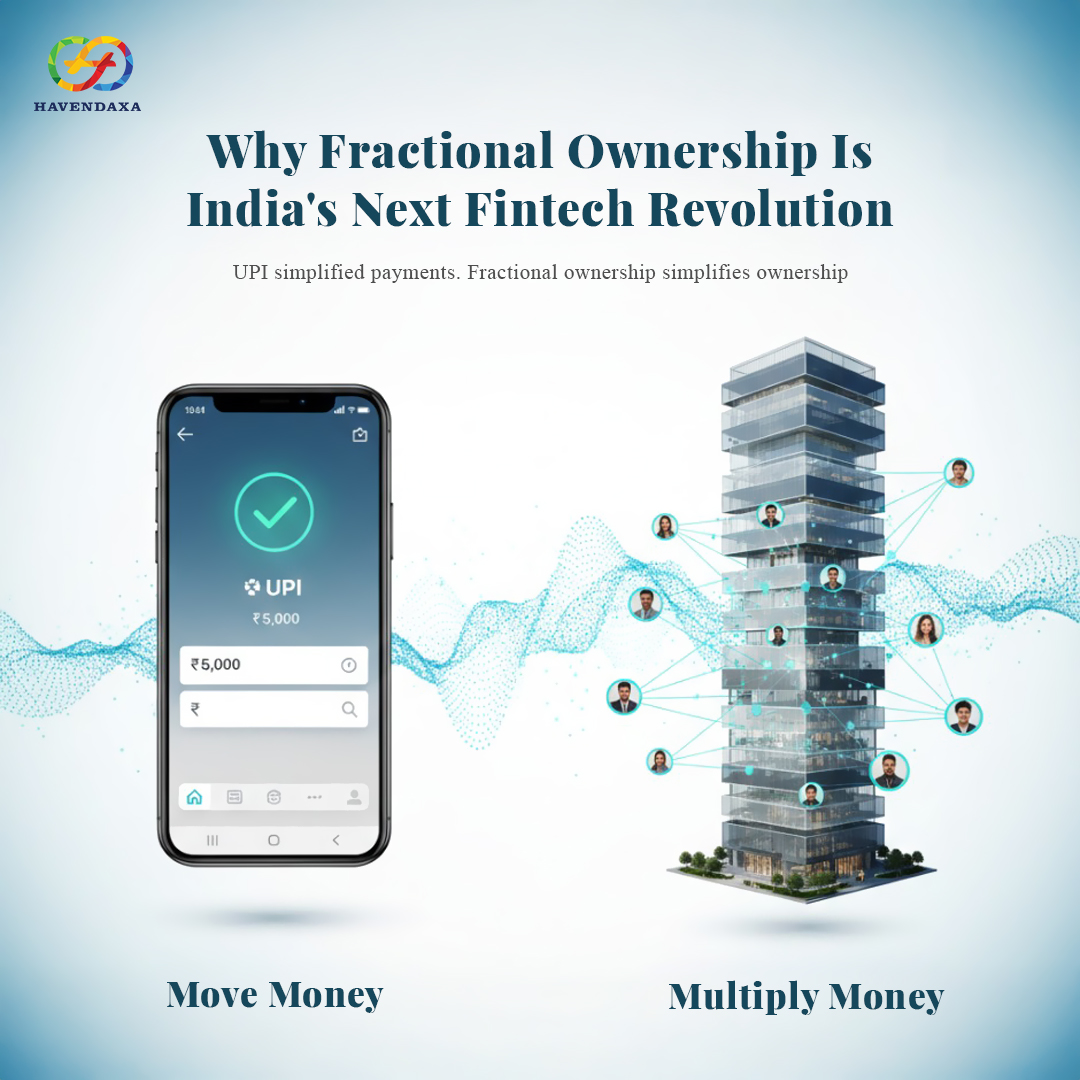
Why Fractional Ownership Is India’s Next Fintech Revolution
Previously, in India, whenever anyone claimed that he/she owned a fraction of premium commercial property, they were thought to be either born rich or have invested money for a long period. Real estate always seemed like a “big people” game A- enormous capital, tons of paperwork, lengthy procedures, and much waiting.
But there is an exciting trend emerging right now.
In the same manner that fintech applications have transformed savings, investments, transactions, and borrowing in India, fractional ownership is transforming Indian perceptions of real estate.
And let me tell you one thing, it looks like just the beginning of something big.
Since for the very first time in India, high-end commercial real estate assets are being opened up to professionals, entrepreneurs, Non-Resident Indians, start-up founders, salaried employees, and modern-day investors who earlier believed that premium properties were beyond their means.
It is precisely for this reason that many believe fractional ownership in India has the potential to be the next fintech revolution in the country.
And once you comprehend the “why” behind it, it starts to make a whole lot of sense.
Real Estate Was Important Always – It Just Lacked Accessibility
Real estate has been a trusted investment choice of Indians from time immemorial.
If you ask almost any individual about his source of “real” wealth, he would invariably cite land, commercial property, or income-producing assets.
It was not really an issue of trust.
It was all about accessibility.
The purchase of an office property, warehouse property, hospitality property, or leased commercial property requires enormous amounts of capital for most people. Even making one’s entry into high-value commercial properties markets such as Gurugram, Mumbai, Bengaluru, or Hyderabad was an unachievable dream for many investors.
This was precisely where fractional ownership found its place.
Fractional Ownership - So What Exactly Is It?
In layman’s terms, fractional ownership allows multiple individuals to jointly own a premium real estate asset rather than having an individual own the complete asset by themselves.
Consider a leased office space of premium value at ₹25 crores.
Under the traditional system, only a highly affluent individual or organisation would be able to purchase the property.
Now consider the same property being jointly purchased by 100 individuals.
Immediately:
Access becomes easier
The risk gets spread
Investors can get access to premium assets
Revenue generation through rental income is now possible
Wealth creation becomes widespread
This is where the similarity between the two ends.
Because this is not merely a “real estate concept.”
It’s much more than that.
Fintech Made Money Easy. Fractional Ownership Makes Investing Easy.
Consider the impact of fintech on Indian finance.
It made things easier.
Before:
Investments needed brokers
Trading was intimidating
Payments took time
Financial instruments were difficult to understand
After platforms entered the game, they transformed the habits of users by:
Making things technological
Increasing accessibility
Improving transparency
Making digital onboarding easy
Making investing simple
Now consider what's currently taking place in contemporary commercial real estate investing.
The likes of Havendaxa are democratising institutional-quality real estate deals in a platform-driven, transparent environment where investors are at the centre.
And this revolution is massive.
Why?
Because today's consumers don’t want complicated investments for no good reason.
They seek:
simplicity
transparency
digital accessibility
secured assets
professional management
and financial gain
Just like fintech did successfully.
India’s New Investor Thinks Very Differently
This generation doesn’t invest as previous generations did.
Today’s investors:
compare returns online
track assets digitally
expect transparency
diversify aggressively
Research before investing
prefer convenience
They’re also far more open to alternative investments than older generations ever were.
That’s why concepts like startup investing, REITs, SIP culture, Digital gold and crypto awareness grew so quickly in India.
Fractional ownership fits perfectly into this behavioural shift.
Especially because investors can now explore professionally managed assets across: Hotels, Office spaces, Warehouses, Hospitals and commercial buildings,
Premium plots without needing to independently purchase entire properties.
The Biggest Benefit? Premium Properties Become Accessible.
What most people do not realise about premium commercial properties is just how hard it is to get access to them without assistance.
The typical premium commercial property needs:
- Substantial financing
- Legal coordination
- Tenant coordination
- Operations management
- Property maintenance
- Due diligence
- Documentation
For most investors, they simply do not have enough time or experience for all of those things.
With fractional investment, that changes everything by providing professionally-managed investment vehicles that manage operations, tenants, documentation, and property management.
This represents an enormous change in psychology.
As it allows investors to focus on their investments rather than their properties.
Other Reasons Why Commercial Real Estate Is Attracting So Much Interest
There is another reason why this industry is booming at an increasing pace.
People are now aware that some types of commercial property have better rental earning potentials than many of the residential properties.
Examples include:
- Leased offices
- Warehouses
- Hospitality
- Healthcare facilities
- Retail commercial spaces
All of which have recurring lease structures or income-earning models.
It raises interest among people who want:
- Recurring rents
- Capital appreciation
- Diversification
- Inflation-linked growth
And not just because it is a speculative trend, but because there are physical income-generating assets involved.
This aspect of having income-generating assets behind it is very important in India.
Technology is Where It’s at
To be completely honest, fractional ownership wouldn’t have scaled as quickly without technology.
Technology enables:
- Investor onboarding is to be streamlined
- Dashboards to be available
- Reporting to be transparent
- Due diligence to be organised
- Documentation to be managed
- Investments to be tracked
Today’s platforms allow access to:
- Ownership history
- Property details
- Rental information
- Financial information
- Tracking systems for investments
- All via digital means.
- This is very fintech-like behaviour.
It’s precisely the reason the industry doesn’t feel so much like real estate anymore.
India Is Just Beginning Its Transition
And that is possibly the most fascinating thing about it.
India's fractional ownership landscape is still nascent compared to its potential end destination.
But the factors driving demand are clear to see:
Increase in alternative investments, greater understanding of commercial real estate investors who are digital-first, more focus on creating wealth, passive income-seeking tendencies, tendency towards diversification.
In some respects, we are seeing the beginning of an investment trend transition.
Just like how UPI started slow before becoming ubiquitous...
Fractional ownership may also follow a similar adoption trajectory in premium real estate investment.
Starting slow.
Suddenly everywhere.
Closing Thoughts
Why fractional ownership in India seems so revolutionary is not merely because one can co-own property.
That is because the entire process of investing is transforming.
Real estate is becoming more accessible, more transparent, more tech-oriented, more professionally managed and much more aligned with today’s investors’ expectations. And frankly, it was about time.
For years, high-end commercial real estate investments have been restricted only to institutional and ultra-high-net-worth individuals.
But now the floodgates are slowly but surely opening up.
Platforms like Havendaxa are a part of this larger movement by enabling investors to discover premium income-generating real estate opportunities via innovative fractional ownership methods with a strong focus on transparency and accessibility.
And if the trend continues, fractional ownership might not remain a fad.
It may well revolutionise the way Indians invest in real estate for years to come.